Syllabus Coverage: NFC1.1
The purpose of milling is to concentrate the uranium extracted from the mine into a tradeable product. Since mined ore typically contains only about 0.1-1 wt% uranium, the mill is almost always co-located with the mine to avoid transporting vast quantities of low-grade rock.
The final product of milling is uranium ore concentrate (UOC), commonly known as yellowcake due to the strong yellow colour of ammonium diuranate (ADU). Yellowcake is a traded commodity, priced in terms of $/lb U₃O₈.
The milling process involves several key steps, shown in the flow chart below:
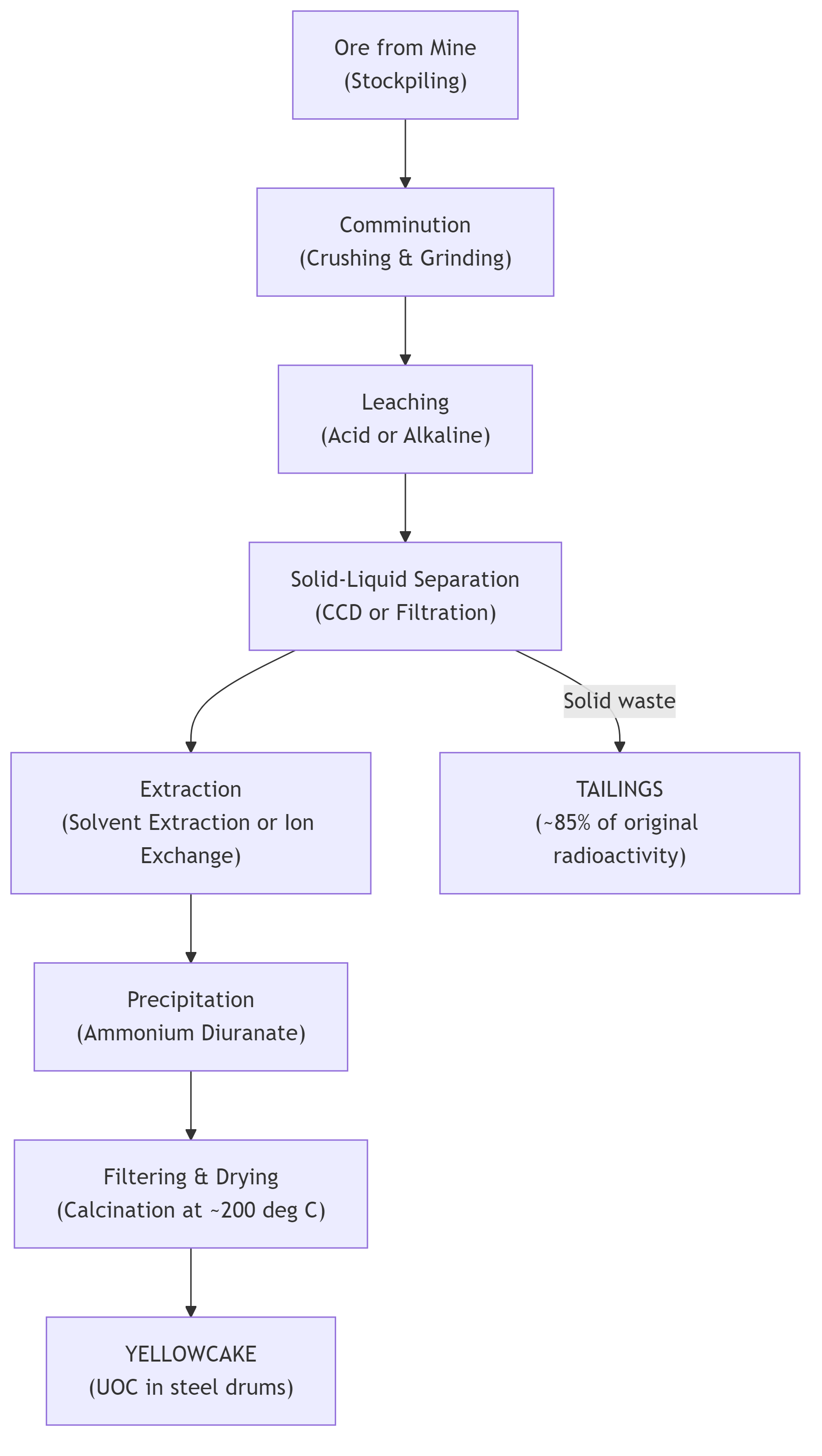
Step 1: Stockpiling
Ore delivered from the mine is stockpiled in heaps to provide a buffer for the milling operation, ensuring a continuous and consistent feed.
Step 2: Comminution (Crushing and Grinding)
Comminution is the process of reducing the particle size of the ore to make it suitable for chemical leaching. This is typically a three-stage process:
- Primary crushing (jaw crusher or gyratory crusher): Reduces fragments to ~15 cm
- Fine crushing (cone crushers): Reduces to ~2 cm
- Fine grinding (semi-autogenous grinding, SAG mills): Reduces to sub-millimetre particles suitable for leaching
Step 3: Leaching
Leaching is the chemical process of dissolving uranium from the crushed ore while leaving the solid waste (called gangue). There are two main methods:
- Acid leaching (most common): Uses sulphuric acid (H₂SO₄) to dissolve the uranium. Performed at ~50 degrees C for 3-10 hours in rubber-lined, agitated steel tanks. Achieves 90-98% uranium recovery.
- Alkaline leaching: Uses sodium carbonate (Na₂CO₃). Used when the ore is rich in acid-consuming minerals such as calcite and dolomite. Slower kinetics but more selective.
Key Chemistry: Uranium naturally occurs in two oxidation states: U(IV) in UO₂ (insoluble) and U(VI) in UO₃ (soluble). The U(IV) must first be oxidised to U(VI) before it can be leached.
Step 4: Solid-Liquid Separation
The uranium-bearing liquid must be separated from the solid waste. The most common method is counter-current decantation (CCD), which achieves ~99% recovery in 4-6 stages. Horizontal belt filters are also used.
Step 5: Extraction (Purification and Concentration)
Either solvent extraction (SX) or ion exchange (IX) is used to recover and concentrate uranium from the leach solution:
- Solvent extraction: The uranium-bearing aqueous solution flows counter-currently with an organic solvent (typically a tertiary amine — the “AMEX process”). Uranyl ions are selectively transferred to the organic phase, purified, then stripped back into a clean aqueous phase.
- Ion exchange: Uranyl cations are selectively absorbed by a resin, then stripped using a salt solution.
Step 6: Precipitation, Filtering, and Drying
The purified uranium solution is treated to produce a solid product:
- The solution is limed (pH raised)
- Ammonia gas is bubbled through, precipitating ammonium diuranate (ADU): (NH₄)₂U₂O₇
- The ADU solid is separated by centrifuge and washed
- Dried (calcined) at approximately 200 degrees C to produce a free-flowing yellow powder
- Packed in simple steel drums with polythene liners for shipment
This dried product is yellowcake — the tradeable output of the milling process.